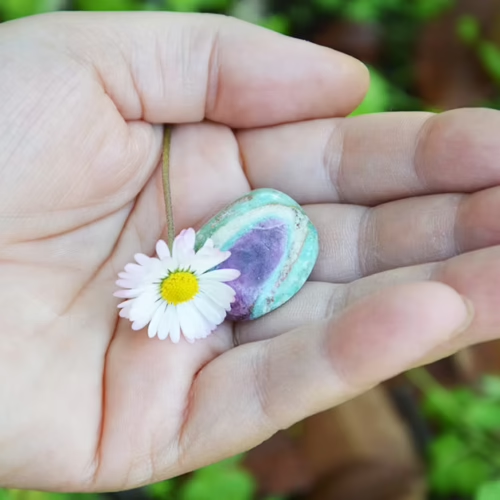
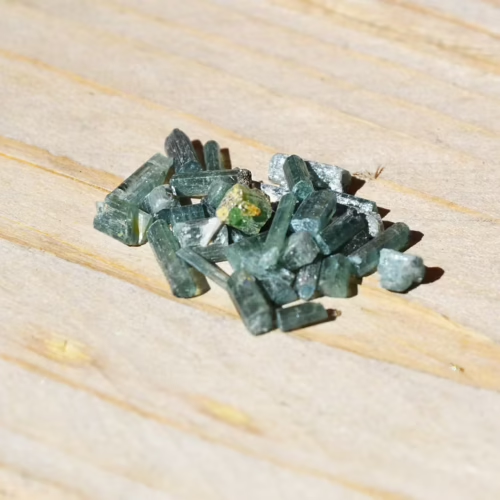
Today, friends, I want to talk to you about a stone that is not easily found but is so interesting that I thought it was important to introduce it to you: Black Jade.
A bit of history
The name “jade” comes from the Spanish piedra de ijada, meaning “stone of the loins”, due to its traditional beneficial effects on the lower back and kidneys.
Black Jade dates back to the time of the Spanish conquest of Central America, where it was highly valued and finely worked.
The Aztecs believed that jade was a sacred talisman that not only protected from evil but also allowed safe communication with the spirits.
Admired since ancient times, jade has been used around the world by ancient civilizations to create various objects and ritual symbols. However, it was the Chinese who first considered it the most precious stone in the world.
Jade slabs circulated alongside coins. To their eyes, it was the noble stone par excellence, regal, a symbol of purity, considered “the crystallization of moonlight or starlight.”
Confucius (551–479 BCE) expressed the deep respect and love the Chinese had for the gem with these words:
“Jades are soft and smooth like benevolence, strong and compact like intelligence, sharp-edged without cutting like justice, beautiful like sincerity, and emit long clear tones like celestial music.”
He also taught that a man should shape his manners and conduct according to the virtues of jade.
In ancient China, jade was used as a base ingredient in remedies that could cure many illnesses. Texts describe that crushed jade mixed with gold and silver could revitalize all organs and extend life. Even jade liquor, made with powdered stone, rice, and drops of dew, was said to stimulate circulation and purify the blood.
In ancient China, jade was sacred and used to make urns, as it was believed to prevent corrosion and ward off evil spirits.
During funerary rites, the eyes and mouth of the deceased were covered with small jade cicadas (symbolizing summer and crop ripening), and the orifices were sealed with jade cylinders, preventing spirits from leaving the body abruptly and disturbing family and friends.
Another ancient Chinese custom involved embedding pieces of jade in the foundations of homes, believed to keep the family united and protect the house from natural disasters.
These examples, in brief, tell us that jade stones were generally considered healing, protective, and guardian stones.
Jade colors and their properties
Jade comes in various colors (gray, grass green, yellow, blue, and black), depending on its mineral composition and iron oxide content.
Black Jade is considered the ultimate protective stone. Like all black crystals, it absorbs negative energies and releases positive ones. It also brings security and stability.
By eliminating tension, it makes people more resilient, persevering, and strong. Black relaxes the entire body and counteracts the tendency to disperse energy, enhancing focus and concentration.
It also helps bring past memories to the surface and encourages a person to seek their inner light.
I highly recommend this powerful crystal to all therapists: it is a true force of nature for those who frequently work with people who suffer.
I must say that in the past few weeks, I have faced several very negative situations, but this crystal gave me the strength to handle difficult circumstances, especially with my clients.
Recently, I noticed that when I write about particularly powerful crystals on Facebook, intense anger can erupt: even very kind people can suddenly change their demeanor. Dear readers, I understand that I cannot always satisfy everyone, but crystals are not made by humans, they are gifts from the Earth and masters of wisdom. I ask you to approach them with great respect and love, as they are far more than simple stones…
They are magical. They are alive!