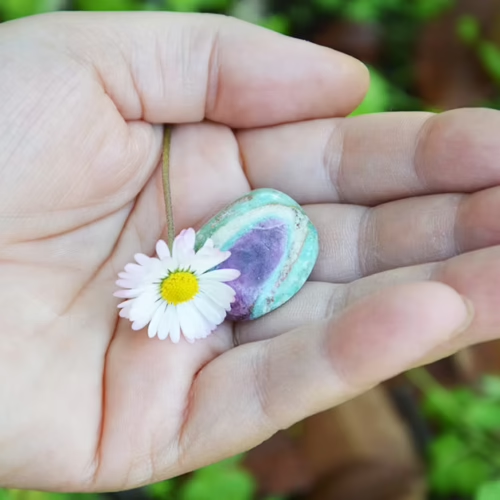
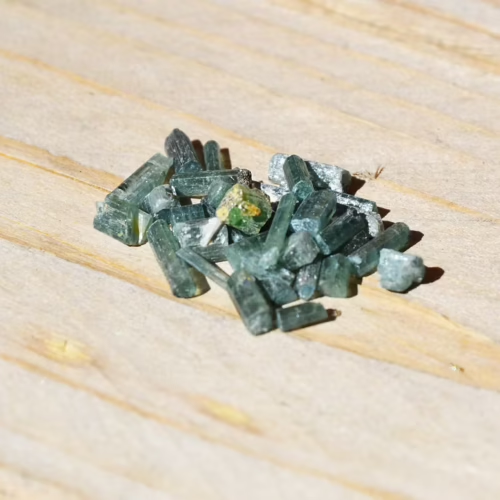
Garnet is a stone that belongs to a very large family, comprising a wide variety of crystals with differing chemical compositions and an extensive range of colors (black, red in various shades, orange, yellow, pink, green, brown, and blue the rarest in nature). In total, there are as many as 38 different types, linked as you know (do you remember?) by the percentage presence or bonding of certain metals (calcium, magnesium, manganese, ferrous iron, aluminum, ferric iron, chromium, vanadium).
Some famous garnet deposits are found in Germany, Russia, Namibia, Bohemia, South Africa, Madagascar, Brazil, Australia, Burma (Myanmar), Sri Lanka, Mexico, Brazil, India, and less valuable varieties in Italy, particularly in the Alps.
Garnet: name and curiosities
The word garnet derives from the Latin granatus (grain or seed) or garanatus, probably referring to mela granatum or pomum granatum in Italian, melograno (pomegranate). This fruit contains a multitude of seeds covered with a bright, vivid red pulp, comparable in size and color to red garnet gems.
Over the centuries, the name evolved and underwent various changes, becoming gernet (meaning “dark red”) in 14th-century England, and later garnet, which today designates the stone in the English language.
The most well-known variety of this stone is certainly the red one, to which all magical properties were originally attributed.
Throughout history, garnets have always been highly appreciated and sought-after stones. Used to create magnificent jewelry and ornamental objects, they have inspired legends and traditions in many parts of the world.
Ancient peoples associated garnet with blood. Indigenous cultures in Brazil called it “the blood of the Earth” and believed it was responsible for soil fertility and the richness of tropical vegetation.
Garnet was also used as a sacred stone by Native Americans, the Aztecs, African tribal populations, and the Maya.
Jewelry and ornaments dating back more than 5,000 years demonstrate that garnet is a durable and resilient stone, highly prized since ancient times (by the ancient Egyptians, Greeks, and Romans).
The famous Greek philosopher Plato (428–348 BC) had his portrait engraved by a Roman gem cutter on a garnet stone. Pliny, who called it carbonculus meaning glowing coal attributed to garnet the ability to cheer the spirit and dispel sadness.
This stone is also mentioned in the sacred texts of various religions. For example, it is said that to illuminate the Ark during the Great Flood, Noah used a garnet which, skillfully cut, could reflect the scarce light available and thus illuminate the entire vessel.
Traditions and Legends of Garnet
Garnet, especially the red gems, is part of Christian tradition as it is considered a symbol of Christ’s sacrifice. In Jewish sacred writings, it is one of the twelve gems of Aaron’s breastplate (hoshèn), and in the Qur’an it illuminates Islamic Paradise thanks to its astonishing brilliance.
In Greek mythology, it is mentioned in the episode of Persephone’s abduction into Hades; in Jewish and Muslim traditions, its splendor is praised.
Beyond legends, red garnet was also worked and cut as a precious stone: the Vikings already used garnet jewelry as funerary ornaments to illuminate the path of the dead toward Valhalla.
A particularly interesting Eastern belief holds that garnet has not only the power to protect its wearer from negative energies projected by others, but also to repel those energies back to their source.
Garnet was central to many legends and folk traditions. In the Middle Ages, it was associated with the carbuncle, the legendary stone that shines in the dark and brings light and hope to souls in darkness. It was also believed to protect against eye diseases, the plague, wounds (it was thought to stop bleeding), and poison.
Furthermore, it was used to dispel melancholy, ward off depression and evil spirits, and banish nightmares especially those linked to night and darkness (such as demons and ghosts) as well as to bring forth truth, faith, and perseverance.
It was also considered the stone of heroes, dedicated to those capable of enduring harsh trials to prove their courage. Crusaders decorated armor and sword hilts with this gem to gain greater courage and energy in battle, as well as protection.
Garnet also adorned amulets as a bearer of happiness and wealth, and women gave it as a token of love especially wives during the Crusades, so they would not be forgotten.
However, it was during the 18th and 19th centuries that garnet was particularly loved and in demand, especially Bohemian garnet (now part of the Czech Republic), which was renowned as a primary source of splendid crystals. Garnet craftsmanship was among the country’s most prosperous industries, and Bohemian jewelry was known for its unique and distinctive cuts and settings.
Garnet’s purpose is to bring to light something “precious” that belongs to a person something to be valued and consciously recognized.
Colors and Emotions of Garnet
Color influences the analysis of every gemstone, but for the analysis to be relevant, it must also consider the emotions that a given color and stone evoke in a person.
This does not prevent us from exploring and understanding the meanings that popular tradition attributes to different gemstones. Through garnet so beautiful and precious we can better understand matter in order to search within ourselves for subtler aspects.
Energy, matter, and passion must be evaluated through felt sensations.
If there is no matter, there is no energy either; therefore, it is pointless to deny matter in order to be spiritual. The two must work hand in hand, like a partnership moving together.
Properties of Garnet
Garnet is a symbol of money and wealth always in the right balance. Learning to remain balanced is essential to perceiving subtle energy.
Garnet purifies and re-energizes the chakras, bringing serenity or passion depending on the situation. It inspires love and devotion, balances sexual desire, and alleviates emotional disharmony.
In particular, it stimulates kundalini energy and enhances sexual potency. It activates both the Root Chakra and the Crown Chakra to facilitate a free flow of energy along the spine, distributing the right amount of vitality to each part of the body.
Thus, it can help balance and unblock our inner energy, especially that of the first chakra, Muladhara. When used for this purpose, it signifies good grounding and a solid reserve of energy, fostering a strong connection to the Earth, which provides strength.
This stone tends to give form, clarity, determination, and discipline to energies, making them constructive and stable.
Precisely because of this consolidating influence, garnet can be helpful for people undergoing significant growth, such as during adolescence the transition from childhood to maturity.
Garnet helps one emerge from situations that seem to have no way out. It is the most suitable stone during times of crisis, when the collapse of values and hopes generates profound existential difficulty. It strengthens inner fire, the desire for self-affirmation, and the capacity for cooperation.
It supports individuals in carrying out daily tasks and encourages looking beyond one’s narrow personal horizon to engage in the collective good.
It promotes self-confidence, willpower, and joy of living, instilling courage, hope, and optimism. It helps people view obstacles as challenges worthy of being faced.
It is considered an excellent therapeutic stone for both sexes: worn by men, it stimulates proper functioning of the reproductive system; worn by women, it rebalances hormone levels and reduces swelling caused by hormonal imbalances. For both, it is an excellent energizing stone for sexuality and fertility.
It helps release unnecessary taboos and inhibitions, enriching sexual life. It is therefore an exceptional stone for couples who wish to explore more deeply their mutual attraction, their sexual relationship, and the passion they feel for one another.
From the perspective of love, it helps strengthen commitment, dedication, and fidelity, aiding in the discovery of true love.
It also helps free oneself from past conditioning and obsolete ideas, contributing to the creation and beginning of a new life and the dismantling of destructive and unnecessarily limiting behaviors.
It stimulates the development of new ideas and strengthens the ability to put them into practice, despite opposition from others.
It removes energetic blockages, aligns the subtle bodies, and increases creative and imaginative capacity.
The Gem of Wealth? Garnet!
It is also a very powerful talisman for attracting money. Essentially, it is a luck-attracting stone whether the goal is financial gain or the achievement of objectives.
Even today, this stone enjoys a reputation for attracting people to whoever wears it. This quality can be useful both personally and professionally, making it particularly suitable for those whose work involves the public or requires interaction with others.
One of the most appreciated virtues of this stone is the support it provides in overcoming depressive states. It has the power to dissipate negative attitudes and helps free the mind from obstructive and pessimistic thoughts.
Moreover, it balances and restores our inner energy, generating greater self-confidence and allowing our spirit to shine. It also enhances survival instincts during times of crisis or traumatic events, helping courage emerge and instilling hope.
In addition to being a valuable aid in overcoming depression, this stone offers support to those who wish to undertake major changes in their lives or face new realities.